We've hit a real travelling wall. Again. India does that to you.
Being enterprising, overachieving doctor types, we had been whizzing through India at a breakneck pace. However, the consistent three-hour train delays, the miasma of pollution that besets every city, the incessant noise, and the even more incessant touts finally wore us down. We decided to scale back on our travelling and, instead of trekking out to Jaisalmer, the westernmost tourist destination in Rajasthan, we have decided to stick with Jodhpur, Pushkar, and Jaipur.
Jodhpur was a relief. Also known as "the Blue City," its buildings are painted varying shades of cerulean and aquamarine. Initially, this was a mark of status, and now it supposedly functions to ward off mosquitoes. Its fort, the Meherangarh, towers over the city from a rocky perch, and claims to have never been taken in its 500 year history. The Meharangarh is still owned by the maharajah of Jodhpur, and he struck us as a surprisingly conscientious ruler. Although divested of actual kingly powers, when he inherited the title he took over the crumbling fortress and restored it. The initial renovations were funded by proceeds from the sale of bat guano that littered the palace, and later by the tourists that came to visit (is there much of a difference?). He even solved the dilemma of the "Indian" vs "Tourist" prices by justifying the latter with an excellent included audio tour and free camera priveleges.
Pushkar was next. It lays claim to being one of the holiest cities in India, with 400 or so odd temples (including a rare Brahma temple) dotted around a small central lake. Here no alcohol, meat, or eggs can be had for any price and holding hands in public is not allowed. Unfortunately, we decided to come for the annual Pushkar Camel Fair (sponsored by Vodafone! Be a Part of the Live Epic!), and holy it did not seem. Besides the hundreds of camels and traders camped out west of the fair grounds, thousands of pilgrims surged into the town in order to bathe in the lake on the day of the full moon. Our 48 hours there was characterized by extreme pollution from the hundreds of campfires, constant noise from the four or five competing citywide PA systems, and gangs that were suprisingly adept at filching cameras (luckily not ours). The entire event was not nearly as National-Geographic-worthy as it might sound. It included such kitschy events as a tug of war between barefooted Indian women and burly white guys (the former won), parachute drops, and camel races. All this was topped off by our hotel, which was undoubtedly the biggest ripoff in India. Not only did the owner—a holy man himself—charge us ten times the going rate for a hotel room, but when we hired a private taxi to go on to Jaipur he tried to convince us that we should also transport his brother with us for free. (A major accident on the road! They called for him urgently! Notwithstanding the fact that his brother was sixteen and had spent the hour before primping to meet a girl). Ah, travelling in India.
Jaipur, the capital of Rajasthan, made us realize something. We are unabashedly "city people." On arrival here we stumbled upon a McDonald's, which we frequented three times in fewer days (no beef, but the Chicken Maharajah Mac can hold it's own against the Big Mac) and purchased tickets to Saawariya, a three-hour-long Bollywood epic showing the Raj Mandir Cinema, the world's only meringue-shaped movie theater. Dirty, polluted, and hectic, some travellers bypass Jaipur for the more picturesque cities in the south and west. However, it is not without its charms. Painted elephants and decorated horses share the road with the rickshaws, scooters, and cars. The old city, nicknamed "the Pink City," has rows of bazaars that sell anything from spices to Singer sewing machines. Planted at the intersection of 2 major roads is the Hawa Mahal, or Palace of Winds. Here, royal women who observed purdah (veiling of women from men and strangers) could choose a nook in this remarkable tiered building and peep out behind plaster screens. And, of course, Jaipur has its own fort, named Amber, but pronouced Ameer.
In overhearing a conversation between our hotel owner in Jaipur, I have come to one sad conclusion. Travelling as a tourist in India (and most other countries) exposes you to the worst segment of society. By that, I mean the touts, the travel agents, the hotel owners, the shopkeepers. Paramount in their interaction with you is their desire to earn your money. Our hotel owner is from Agra, and a guest was doing a day trip out there to see the Taj Mahal. "You will not like Agra, " he said. "The people you meet there will harrass you and follow you around. We in our circle there know nice people, but you as a tourist will be meeting a different circle." It is only rare that we meet an exception.
We did indeed yesterday, when we made a 7 hour return journey to Ranthambore national park to spot some tigers (we failed). The highlight of our trip was not sighting wild animals in the sanctuary, but rather a visit to our driver's sister's new house, where they treated us to chai and guava sprinkled with chili powder and salt. They proudly took us around their new home, pointing out the marble doorframes and the spacious kitchen. They offered to let us stay the night so we could attempt another safari in the morning. When we politely declined they were truly disappointed, and our driver on arrival back in Jaipur offered to take us to his house for dinner. There were no strings attached, no attempts to visit "my uncle's souvenir shop." Only much appreciated and genuine hospitality. It was a breath of non-polluted air.
We have to tell you about Agra, yet. But the Taj Mahal is better told in pictures, and those are yet to come.
26 November 2007
Omelettes in Jodhpur and Lassis in Jaipur

17 November 2007
Aghast
Varanasi defies superlatives. Which is a good thing, since I may have used up all my superlatives in my account of travel through Tibet.
But, I get ahead of myself.
Kathmandu to Darjeeling
We arrived in Kathmandu at the start of Deepawali (or Deepavali, or Diwali), the festival of lights. That very fact made us regret treating Nepal as only a stopping-through point on our way to India. The entire city was out, awash in color, candles, light, and hospitality.
It was the latter that most impressed us. We had planned to drive across Nepal to its eastern border and cross, by land, into India. We were loath to break our no-flight rule, since we'd already had to do it once to return from Central Asia. Unfortunately, the Maoists were against us. They were, so we were told, particularly active in the east of the country, the part through which we would have had to drive. Add to that the usurious price-increase demanded by the three-day holiday, and over-land travel became prohibitively expensive and, possibly, dangerous.
So, we broke our rule, and booked a flight. The hand-written ticket which we were given was accompanied by the travel agent's wife's home-baked traditional sweet breads (not to be confused with sweetbreads, thankfully), a not-to-be-refused tilaka, a reservation at his favorite Nepali restaurant, and a pre-order of his favorite meal—he actually showed up not an hour later to join the regulars there in cards. (That the regulars included more than a few creatures bedecked in exoskeletons didn't detract from the fact that the food was a
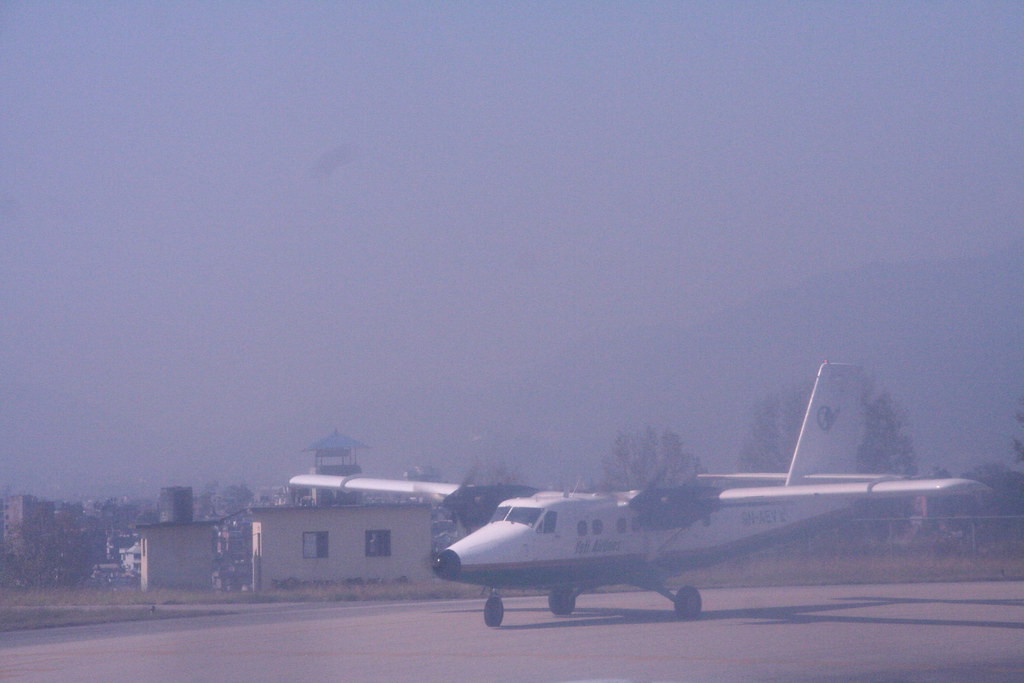
And what a flight that was! It was your typical, developing-world, risk-your-life sort of flight (a twenty-nine seat, properller-driven plane skirting the Himalayas, owned and operated by such a reputable organization as Yeti Airlines), and it lasted forty-five minutes and at a mere 15,000 feet. Lower, incidentally, than we were on land, not three days before. But such stunning views!
We landed, made our final over-land border crossing this trip, on foot into India, and were immediately met by the touts that make this country famous. Crooked rickshaw drivers who promised to take us one place, dropped us off twenty minutes later (for what was supposed to be a three-hour trip), and demanded a full pecuniary consideration. Cousins of friends of sisters-in-law who owned certain shops that we were sure to want to visit. Brothers who could give us special deals. Taxi Romeos, with their Brylcreem'd hair, faces like dissipated potatoes, to-the-xyphoid shirts flashing chains of gold, and porn-star mustaches the thickness of which makes you wonder how they maintain their weight, ever ready to whisk us away to dream-like destinations the likes of which exist only in their minds. And in the Lonely Planet.
But, we ascended to the nearly 7000 foot elevation of Darjeeling, crammed in the back of a jeep designed for five, jostled by an unequivocal lack of asphalt.
Darjeeling
This was India for beginners, and a great way for us to be eased into the subcontinent. Honestly, we did a whole lot of very little. We drank tea (how can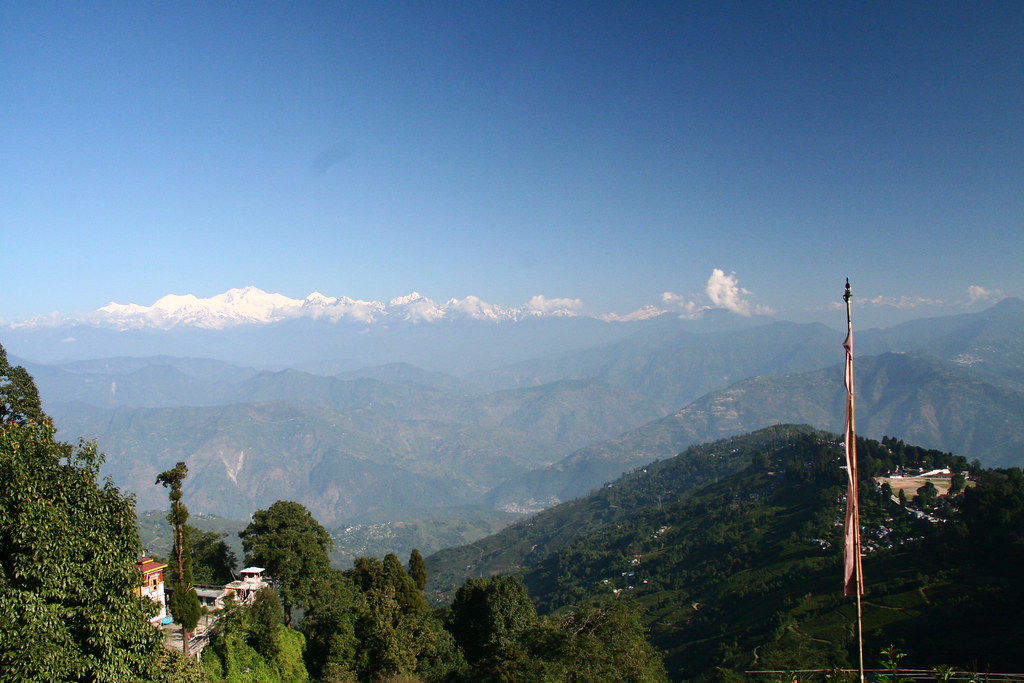
Until we found out that there was Marxist rebel activity at the foot of that hill, too. This was the rebel activity of the blow-up-a-doctor's-car sort, and it threatened to keep us stranded up in the mountains, away from our scheduled train (which may, in the end, not have been a bad thing).
Thankfully, the strike providentially lifted long enough for us to cram ourselves, with twelve others, into another jeep made for five (the driver had to reach between some unfortunate soul's legs to change his gears) and make the treacherous descent down to Siliguri, and into the waiting arms of the train station.
And to begin what may—nephrolithiasis aside—have been the worst thirty-six hours of the trip. To date.
Train stations in India are seething pools of humanity, sleeping under stairs, balancing on their heads cardboard boxes the size of which would have caused Ayn Rand to shudder, drinking from places they shouldn't have been. But—in an attempt at a different sort of humanity—the stations are equipped with "retiring rooms," should you have the misfortune of booking a train at such a God-fearing time as 4:05 am. This attempt at humanity, though, is little more than an attempt. See, the retiring rooms are also home to myriad, multi-legged denizens of the dark. We spent our night, huddled in chairs (it's not a good sign when the sheets have droplets of blood on them), fending off fleas, roaches, bed-bugs, geckos, mosquitoes, flies, and the klaxon of passing trains. Being awoken for the fourteenth time by the patter of many-jointed insect legs on your scalp makes you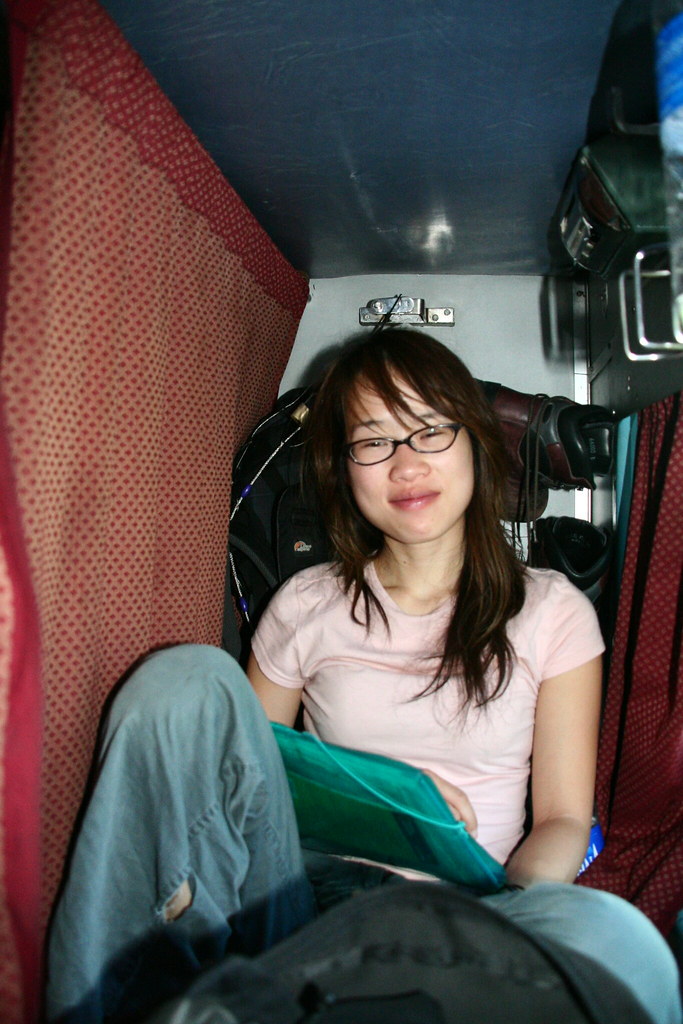
But, board the train we did. When we booked these tickets, we decided to splurge and go for the highest class we could (this splurge cost us on the order of $2 each). Little did we know that the highest class on these trains equals the lowest on other trains.
To say that we were crammed is to understate the case. There are six beds to a berth, four together in a sane, horizontal configuration, and two squeezed against the wall of the aisle. It was into these two that we were assigned. They are less than a person wide, less than a person long, and are meant to fit both you and your luggage, which you are instructed—in no uncertain terms—to padlock to yourself. You are shielded from the outside world by a curtain on one side—through which multiple hands enter, all night, in search of alms or a loose camera—and what passes for a window on the other, darkened on both faces by decades of neglect.
It didn't help that the train's progress consisted of fifteen minutes at a crawl, followed inexplicably by a rest for thirty. The entire way. It covered the 457-mile journey at a speed of eighteen miles an hour, landing us in Varanasi after midnight.
Varanasi
Ah, Varanasi. How can you describe this city? It is an assault on senses you didn't even know you had.
Sudden colors. Pure, deafening pinks and yellows, ochres, oranges, and blues. The sounds of cows, goats, ghats, people, burning corpses, whistles, motorcycles, horns, and generators. But people sit idly by on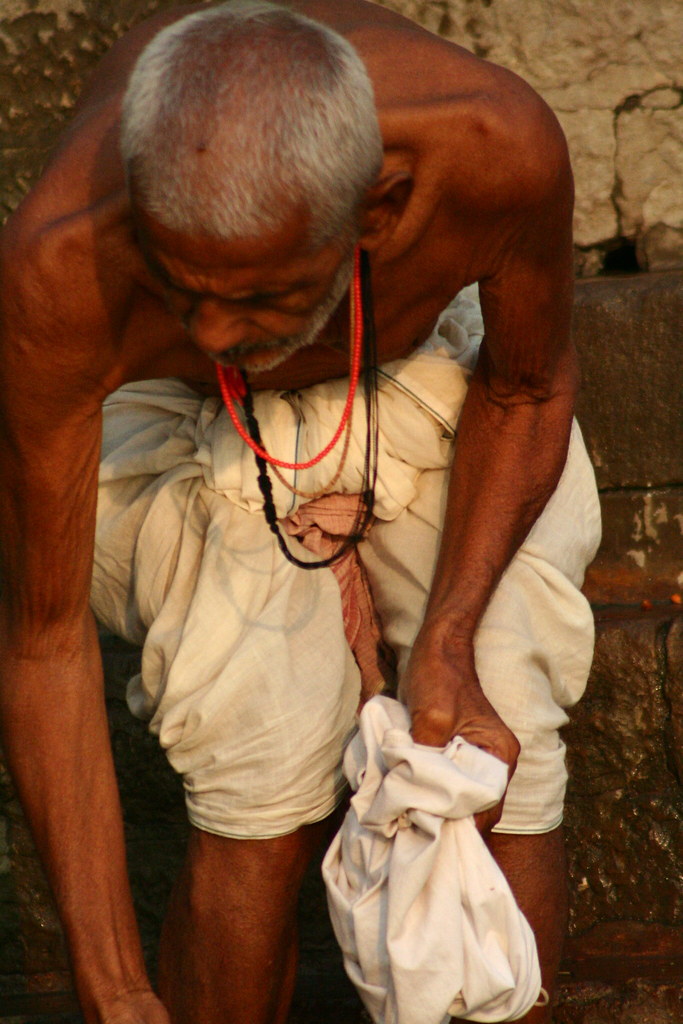
And no wonder. It's said that dying in this city affords liberation from the cycle of death and rebirth. Through the city runs the Ganga, that holy, and wholly-polluted, river in which everything—from bodily functions to the washing of cows to laundry to the quenching of thirst to the final disposition of the deceased—happens. Add to this the sanctity of your bovine companions, and you begin to understand the stuff makes this city what it is.
Into it we went. After three months of lugging around down jackets, fleeces, gloves, and hats, all in preparation for three hours at Everest, we finally decided we would ship the stuff home. We hired a rickshaw to take us to the post-office (hey...it's a confusing city...). But, for reasons inexplicable to us, there was significant police presence on the streets, and they stopped our rickshaw driver somewhere short of some random post office. We paid him and, not realizing he had been aiming for a place that we hadn't intended to go (we'd scouted out the post office the day before), set out on foot.
On finding the post office, we were commensurately greeted by another mustachioed tout who shuttled us—of all places!—to a tailor. This man summarily sewed our belongings into a cotton pillowcase, with a Keith needle, too-thin thread, and a running-locking stitch. Twenty minutes later and Rs 50 lighter, we discovered that our friendly tout had disappeared, having surreptitiously collected his commission.
We wended our way back to the post office and were invited behind the wood-and-glass dividers separating the efficient staff from the rest of us plebeians (imagine that!). Our be-bindi'd helpmeet handed us a Magic Marker (really!) with which to address said pillow case and a mimeographed (really!) customs declaration form. This latter was peppered with such inscrutable confounders as "Choose the [X] of the package," followed by two blank lines. (It turns out the correct response to this particular double jeopardy is to fill the two lines with "Only gift items.") We paid him more than the average GDP of a small country for ten pounds of winter wear, sent "registered." All this means, though, is that we get a nine-digit number with which we can complain if things go wrong.
"But don't worry sir. Everything OK." We'll find out in a matter of months.
And so, we retired to our fly-surrounded, but eminently peaceful hotel. We tho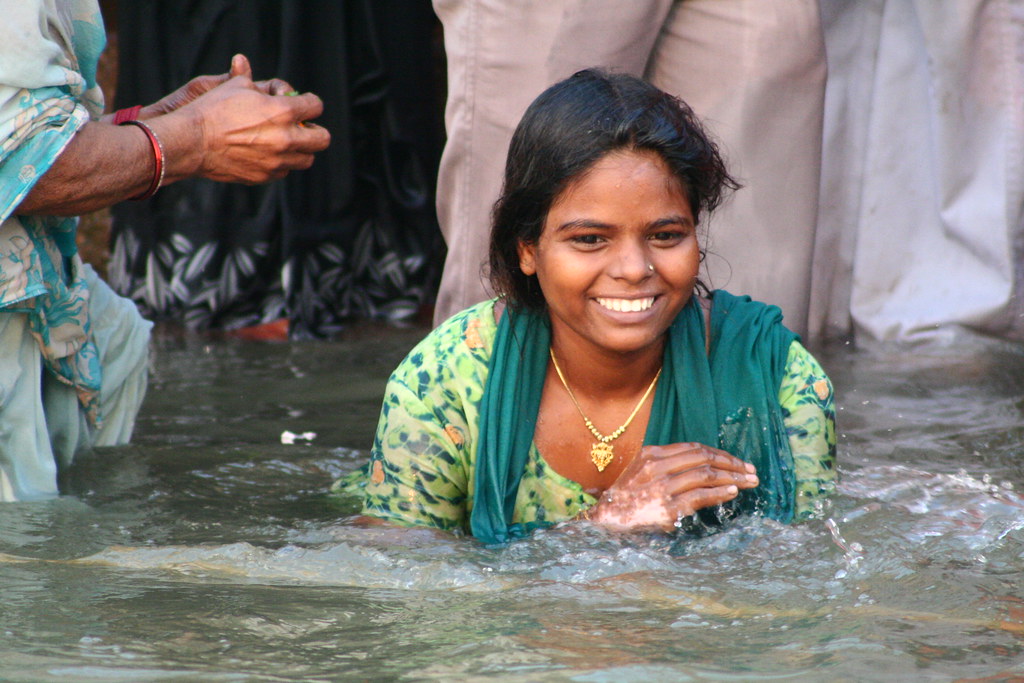
We snatched our cameras, found ourselves a boat made of little more than six garishly-painted planks of wood and commanded by a centuries-old Charon in a blue turban, and plunged ourselves in the wash of life and death that is this amazing city.
15 November 2007
Liberia it is, then
Well, most of the hand-wringing and obsessive e-mail checking is done (who am I kidding? I'll persistently be an obsessive e-mail-checker). It turns out that we will not be in Sierra Leone come the beginning of the year. Instead, Mercy Ships is set to go back to Liberia in February, which is where we'll be joining them.
We're definitely excited about this opportunity. Since we've done all this reading on Sierra Leone, though, we're having to catch up a bit on what's been going on with Liberia. Excuse a bit of history.
Liberia is Africa's oldest republic, founded in 1821 by the American Colonization Society as a place for freed American slaves to return to; it gained its independence from the US 26 years later. Things were stable for a century and some, but between 1980 and 1989 a series of coups and counter-coups toppled the Americo-Liberian elite government in favor of a more authoritarian government under Samuel Doe, then a Master Sergeant in the military.
The country didn't really come into the modern eye until late 1989, though, when a ruinous civil war broke out, led by Charles Taylor, an Americo-Liberian who had the backing of Burkina Faso, the Cote d'Ivoire, and Libya; he gained popular support in the face of Doe's supposedly dictatorial rule. Over the next fourteen years, however, the ensuing violence saw over a quarter of a million people killed and countless others displaced. Finally, in 2003, under pressure from western powers, Taylor stepped down and accepted asylum in Nigeria, from which he was extradited just last year to face trial.
Things settled down. On 8 November 2005, after a run-off election, Ellen Johnson-Sirleaf—the erstwhile head of the UN Development Program for Africa, and a Harvard-educated economist formerly in the employ of Citibank and the World Bank—became the first female head of state to be elected in Africa. And she's brought about significant change, most recently including work toward the cancellation of Liberia's international debt.
As it stands though, Liberia is—according to some estimates—the poorest country in the world. Its population of 3.3 million survive on less than a dollar a day. Street lights first hit the streets of Monrovia just a few months ago, but electricity and running water are still unaffordable for most of the population. Pictures of the country one year after the election, courtesy of the BBC, can be found here.
So, that's Liberia where it is today, as far as I can tell from this side of our time there. Mercy Ships have accepted President Johnson-Sirleaf's invitation to return in February, to help in the rebuilding of the country's medical infrastructure. We're excited to get there.